Winter is certainly blustering its way around the country lately, leaving its mark in some surprising places (snow in Jackson, Mississippi??) and refusing to succumb to spring’s advances just yet.

Photo by Peter Eimon via Flickr.com
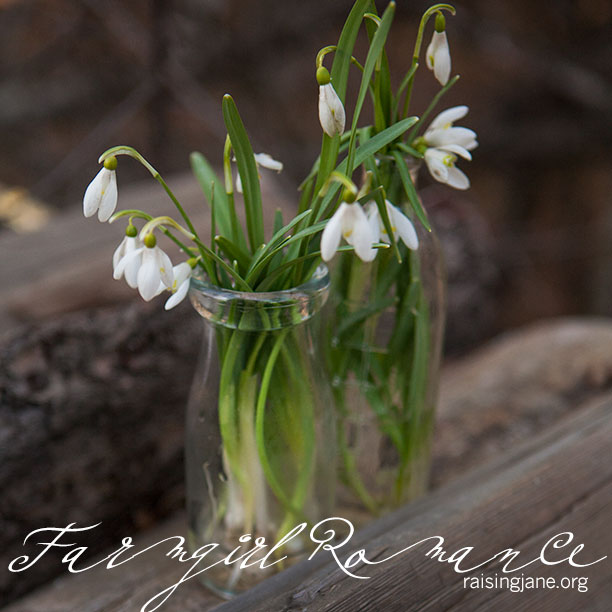
But that makes today the perfect day to share a tidbit of literary wonder called “The Snowdrop” by Hans Christian Andersen. This classic little tale chronicles the emergence of a brave flower that simply cannot wait for spring.
It was wintertime; the air was cold, the wind sharp, but indoors all was snug and well. Indoors lay the flower; it lay in its bulb, under earth and snow.

Photo by Emmanuel Boutet via Wikimedia Commons
One day, though, a slender sunbeam reaches down to the bulb and taps on it. Anxiously, the snowdrop implores the sun to help her break free from the bulb so that she may stretch and grow. But the sun is not yet strong enough. Wait, he tells her. He will be very strong by summer.

Photo by Amanda Slater via Flickr.com
“How long this lasts! How long this lasts!” said the Flower. “I feel a tingling and tickling. I must stretch myself; I must extend myself. I must open up; I must come out and wave good morning to the summer; that will be a wonderful time!”
Déjà vu? I’m sure I just heard you say that yesterday.
And the Flower stretched itself and extended itself against the thin shell that had been softened by the rain water, warmed by the blanket of earth and snow, and tapped upon by the Sunbeam. It burst forth beneath the snow, with a white and green bud on its green stalk, with narrow, thick leaves, curled around it as if for protection. The snow was cold, but light radiated down into it, making it quite easy to break through; and here now the Sunbeam streamed down with greater strength than before.
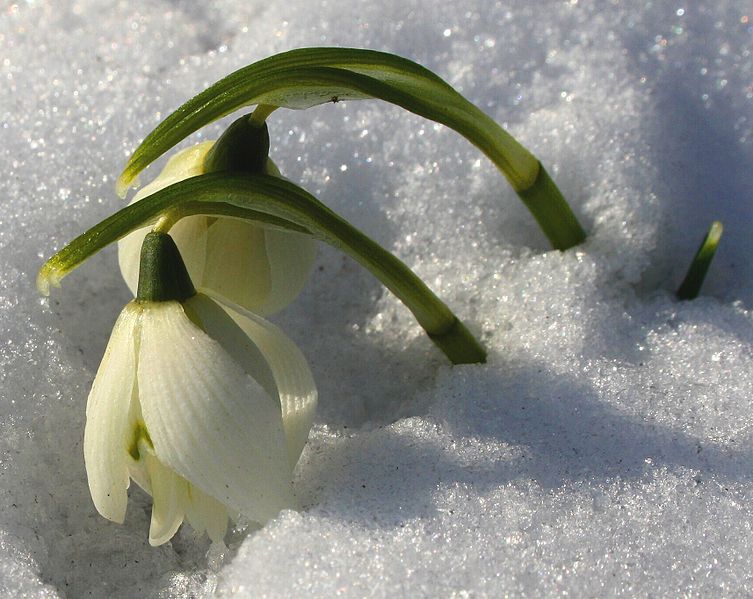
“Beautiful flower!” sang all the Sunbeams. “How fresh and pure you are! You are the first; you are the only one! You are our love! You ring out the call of summer, lovely summer, over town and country! All the snow shall melt, the cold winds be driven away! We shall reign! Everything shall grow green! And then you shall have company, the lilacs and laburnums and finally the roses. But you are the first, so tender and pure!”
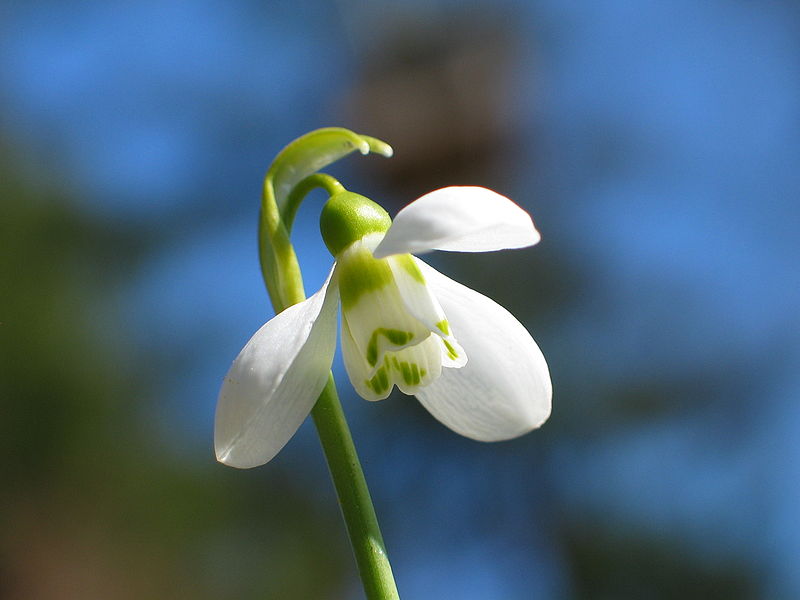
Photo by Jonas Bergsten via Wikimedia Commons
But summertime was far off; clouds shrouded the sun; sharp winds blew. It was weather to freeze such a delicate little flower to bits. But there was more strength in her than even she realized. That strength was in her happy faith that summer must come, and this had been imparted by her own deep desire and confirmed by the warm sunlight. And so with patient hope she stood there in her white dress, in the white snow, bowing her head when the snowflakes fell thick and heavy or while the icy winds swept over her.
And if the snowdrop can hold her own until spring, we can, too. Have you seen your first 2015 snowdrop yet?
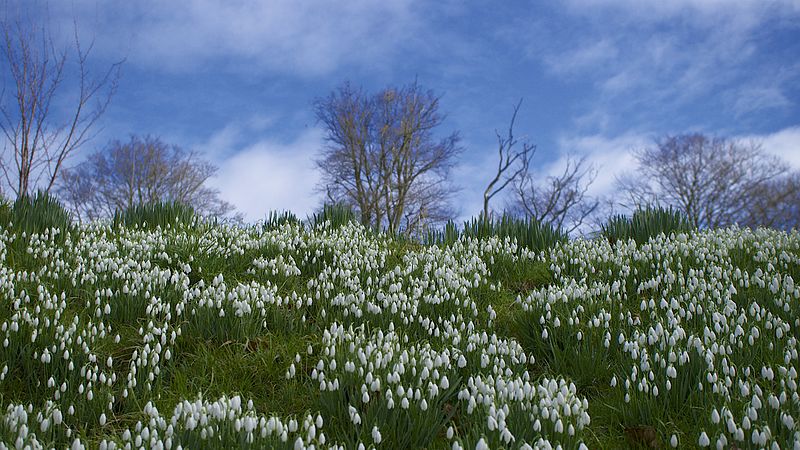
Photo by Ian Kirk via Wikimedia Commons
While wandering around the Internet in search of snowdrop lore, I happened upon this charming video by the folks at BBC that whimsically spins the snowdrop’s story for all ages to enjoy. Share, share, share …